
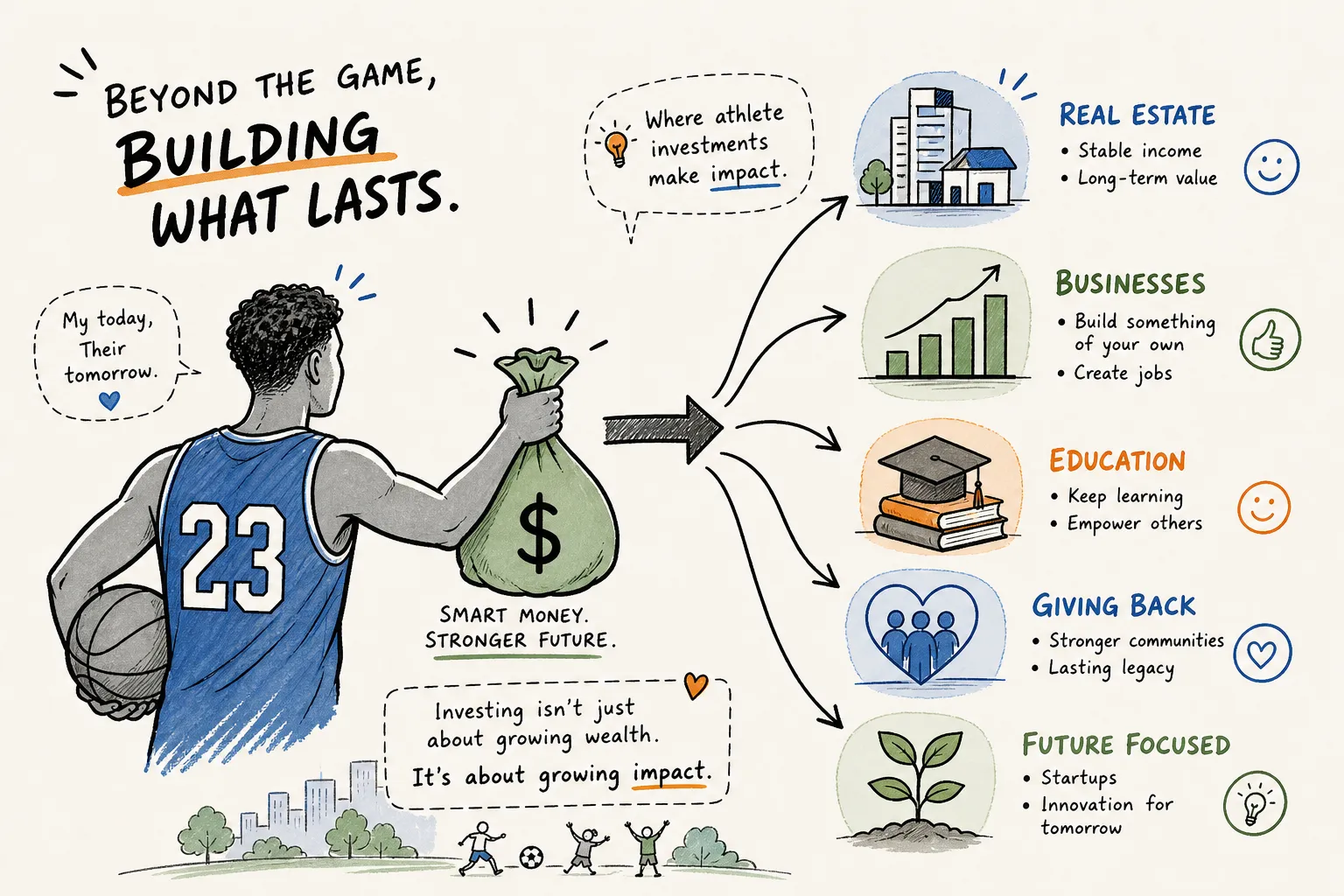
Most fans look at an NFL contract or an NBA max deal and assume that number is the athlete’s wealth. It isn’t. The contract is starting capital, and athlete investments are where the real wealth-building happens. The full story of how sports stars build lasting fortunes plays out off the field, in boardrooms, cap tables, and property deals most people never see. Athlete profiles on Net Worth Public illustrate just how wide that gap gets between what a player earned in salary and what they’re actually worth once investments compound over a career. This article breaks down the four investment categories where pro athletes consistently build wealth, with real examples of who did it and what it paid off.
Why athletes treat their contracts as seed money, not retirement
Professional sports careers average 3.3 years in the NFL, 4.8 years in the NBA, and 5.6 years in MLB, yet retirement can span 40 or more years. The average NFL player retires at 27.6, the average NBA player at 28, and the average MLB player at 29.5. That compressed earning window forces serious athletes to think like investors early, because the financial math simply doesn’t work any other way.
A player who spends without building equity faces a financial cliff the moment their contract ends. The ones who build lasting wealth understand that the contract is a funding round, not a finish line. Many athletes credit trusted advisors, fellow players, or early exposure to entrepreneurship for making that mental shift. The pattern is consistent: high earner, short career, urgent need to make capital work independently of athletic performance.
Athletes who start diversifying while they’re still playing give their portfolios years to mature before the paychecks stop. Financial advisors who work with professional athletes widely note that waiting until retirement to think about investing is among the most common and costly mistakes players make, the career window is simply too short to afford that delay.
Athlete investments in real estate: the most proven wealth builder in sports
Real estate anchors most serious athlete portfolios beneath the flashier bets. It’s tangible and tax-efficient, generating income continuously. For athletes managing uncertain income timelines, rental properties and commercial real estate provide steady, predictable cash flow that feels closest to a regular paycheck, and unlike startup equity, it rarely goes to zero. (Real estate can lose value or become illiquid, but the historical total-loss rate is far lower than venture-backed startups, where roughly half fail within five years.)
Magic Johnson’s commercial real estate empire in underserved urban markets is one of the most documented examples of an athlete turning playing capital into a lasting property portfolio. Hakeem Olajuwon focused on buying high-value, fully developed land for resale; public estimates put his transaction profits above $100 million. Roger Staubach built The Staubach Company into a major commercial real estate firm before selling it for hundreds of millions. These examples are common among high-profile athlete investors with the capital and expertise to execute at scale.
Many athletes start with residential real estate in their home markets, then scale into multifamily units and commercial properties as their understanding deepens. Devon Kennard built a portfolio of 13 properties and 22 real estate deals across the country while still playing in the NFL. The tax advantages through depreciation and cost segregation make real estate particularly attractive for high earners looking to reduce liability during peak income years.
Franchise ownership: buying into proven business models
Franchise ownership gives athletes an established brand and an operating playbook with immediate customer recognition, which cuts the risk that comes with building from scratch. Travis Kelce’s equity deal in Club Car Wash through Wildcat Capital is a clear example: a recession-resistant service business in his home market, structured as an equity play rather than a celebrity endorsement. Athletes have also built wealth through Subway, Chick-fil-A, and auto dealership franchises, businesses that generate income completely independent of anything happening on the field.
Owning a piece of a sports franchise ranks among the most exclusive and potentially high-return athlete investments available, given how consistently franchise valuations have risen across major professional sports leagues over the past two decades. LeBron James’ ownership stake in Fenway Sports Group, acquired in 2011, has grown alongside franchise valuations that have roughly tripled across the NFL and NBA since then. JJ Watt’s stake in Burnley FC reflects a broader trend of American athletes investing in European football clubs at valuations many analysts consider early-stage relative to their long-term growth potential.
The key distinction with franchise investing is cash flow versus appreciation. Service franchises like car washes generate consistent revenue from day one. Sports franchise stakes are long-duration appreciation plays that may not pay out for years. Athletes who understand that difference build portfolios with both, balancing near-term income against long-term upside.
Tech startups and venture funds: where the biggest returns live
The move from writing one-off checks to launching formal venture funds represents a maturation in how elite athletes approach startup investing. Kevin Durant’s Thirty-Five Ventures co-led investments in Robinhood, Postmates, and Acorns, with the Postmates stake reportedly growing from $1 million to $15 million before the Uber acquisition. Serena Williams launched Serena Ventures with a focus on founders from underrepresented backgrounds, building a portfolio that includes Masterclass and several high-growth consumer brands.
Athlete-backed funds and how they source deals
Stephen Curry’s Penny Jar Capital, Giannis Antetokounmpo’s Build Your Legacy Ventures (which led a $13 million round into athlete content platform Scoreplay), and Aaron Rodgers’ Rx3 Ventures each use the athlete’s credibility as deal access, not just as marketing. The approach: formalize the deal flow, build a portfolio thesis, and leverage the athlete’s network to reach opportunities most first-time investors can’t access. These aren’t hobby investments, they’re institutional-style operations built around athlete networks and personal credibility. Some analysts describe them as a form of revenue-share athlete investment, where the fund’s returns flow back through a structure tied to the athlete’s own brand equity.
Athlete startup investing has wide variance in outcomes. The wins tend to share two traits: early entry before institutional money crowded in, and genuine proximity to the athlete’s personal domain, sports, health, or consumer. The losses often involve sectors the athlete had no real insight into, inflated valuations, or trusting an advisor’s pitch without independent diligence. The athletes building the best track records treat startup investing like a portfolio discipline, not a favor to a friend.
Brand equity: when your name on the deal becomes the asset itself
An endorsement pays the athlete once for their image. An equity stake pays them every year the company grows, and pays out massively if the company exits. Kobe Bryant understood this distinction earlier than most. His $6 million investment in BodyArmor in 2014, when the brand was a direct challenger to Gatorade, turned into approximately $400 million for his estate when Coca-Cola completed its full acquisition in 2021, roughly a 67x return, or about 6,600% before taxes and fees, according to reporting by ESPN and the Wall Street Journal.
LeBron James negotiated an equity position in Beats by Dre in lieu of a traditional endorsement fee, and that stake paid out more than $30 million in cash and stock when Apple acquired Beats for $3 billion in 2014. The principle behind both deals is identical: trade near-term cash for long-term ownership, and let the company’s growth do the work. Both athletes recognized an appreciating asset in a growing brand where most people saw a paycheck.
When an athlete holds equity in a consumer brand, their continued visibility actively increases the asset’s value. Every press appearance, every game, every social media moment feeds the brand they own a piece of. For many athletes, this dynamic has produced some of the largest single-event returns in sports finance, the BodyArmor and Beats deals are two of the most documented examples. Outcomes vary by deal, sector, and timing, but brand equity consistently generates a promotional compounding benefit that other asset classes don’t replicate in the same way.
What the gap between contract value and net worth actually reveals
Contract value tells you what an athlete earned on the field. Net worth tells you what they built with it. For some athletes, those two numbers are close, which usually signals poor investment discipline during peak earning years. For others, the net worth figure dwarfs career contract earnings because investments compounded over decades. The BodyArmor and Beats deals alone show how a single well-structured equity position can generate returns that no salary could match.
Understanding which category an athlete falls into requires looking beyond the salary headline and into the investment activity behind it. That’s exactly what Net Worth Public profiles are built to show. The site covers athletes across the NFL, NBA, MLB, PGA Tour, and beyond, breaking down not just contract numbers but the investment activities, business ventures, and equity deals that have shaped each player’s actual financial picture. You can explore focused coverage in our Sports Stars section for sport-specific profiles and analysis.
What to do with this information
Athlete investments follow a recognizable arc: real estate as the foundation, franchise ownership for cash flow, venture bets for upside, and brand equity for the biggest potential exits. The athletes who do this well don’t treat investing as a side interest. They build teams, develop thesis-driven strategies, and start early enough that the portfolio has time to compound before the playing days end.
If you’re a fan trying to understand why your favorite player’s net worth doesn’t match their contract, the answer almost always lives in one of these four categories. If you’re an investor evaluating an athlete-backed fund or platform, and the concept of revenue-share athlete investments or athlete crowdfunding platforms has entered the conversation, the same framework applies: look at the asset class, the athlete’s proximity to the sector, the investment structure, and the liquidity terms before committing. For historical context on how investors have been able to buy a piece of a star athlete, that reporting is a useful starting point. The ecosystem is more sophisticated than most people realize, and the stakes are real.
The next time you see a contract announcement, remember: for the athletes who play this right, that number is just the beginning. Net Worth Public profiles break down exactly how specific athletes made that translation, contract value in, investment activity out. Read detailed examples in our Success Stories section to see the full timeline from paycheck to portfolio. The real wealth is built somewhere else entirely.

MD Belal is a financial researcher and content strategist specializing in celebrity net worth, public records analysis, and high-profile biographies. As the lead contributor to NetWorthPublic.com, he is committed to providing transparent, objective, and thoroughly fact-checked insights. By combining public financial information with market trends, Belal transforms complex financial data into reliable, data-driven stories that readers can trust.