
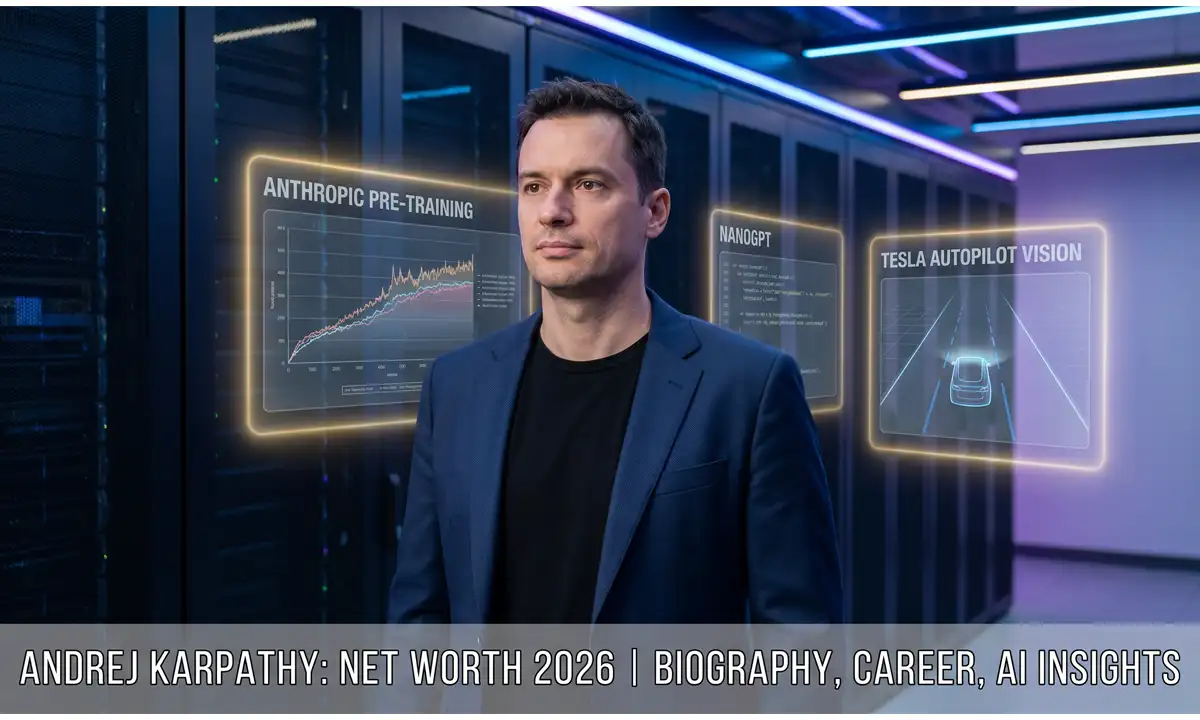
 Andrej Karpathy, a leading figure in AI development and education.
Andrej Karpathy's net worth in 2026 is a multifaceted narrative shaped by his significant contributions to artificial intelligence, from his foundational role at OpenAI to his leadership at Tesla. His financial landscape is bolstered by a dynamic mix of equity stakes, executive compensation, angel investments in innovative startups, and even income from his YouTube channel. This article seeks to present a transparent and comprehensive estimate of Karpathy's wealth, incorporating various elements that contribute to his financial status.
The Evolution of Andrej Karpathy's Career
Andrej Karpathy's journey began at Stanford University, where he earned his PhD in computer science under the mentorship of Fei-Fei Li. His research during the groundbreaking ImageNet era positioned him as a vital contributor to the deep learning movement, making him an ideal candidate for the founding team of OpenAI. Joining in 2016, he was part of a team that would later drive significant advancements in AI. You can also read our guide on disclaimer.
After his tenure at OpenAI, Karpathy stepped into a pivotal role at Tesla as the Senior Director of AI, where he oversaw the development of the Autopilot system until 2022. He briefly returned to OpenAI before founding Eureka Labs in 2024, and in 2026, he joined Anthropic, further expanding his portfolio. Each of these steps has contributed uniquely to his financial profile.
Analyzing Andrej Karpathy's Net Worth Components
OpenAI Equity: The Unquantifiable Asset
Estimating the value of Karpathy's equity at OpenAI poses a challenge due to the lack of public disclosures regarding his stake. Karpathy, being one of the early researchers at OpenAI, likely received an equity grant, especially during a time when the organization invested generously in top talent. For further reading, see deeplearning.ai.
- In 2016, OpenAI reportedly allocated approximately $7 million for its initial set of 52 employees.
- Comparable top-tier researchers received total compensation packages that suggested significant equity stakes, particularly those like Ilya Sutskever.
Given OpenAI's estimated valuation of around $500 billion by late 2025, even a small percentage of equity could translate into substantial value — potentially ranging from tens of millions to several hundred million dollars. However, without solid figures on his retainment or vesting schedule, this portion remains the most speculative aspect of his net worth.
Tesla Compensation: A Cornerstone of Wealth
Karpathy’s time at Tesla from 2017 to 2022 signifies a major contributor to his wealth.
- His role as Senior Director of AI would suggest a comprehensive package, likely worth between $1.6 million per year.
- Over five years, estimates of his total compensation could range from $8 million to $12 million, in addition to the notable appreciation of Tesla stock during his tenure.
Considering publicly available benchmark data, it’s reasonable to estimate that his net worth attributed to Tesla could range from $5 million to $30 million, heavily influenced by the timing of stock vesting.
Angel Investments: A Portfolio of Promising Startups
Karpathy is recognized as an active angel investor, participating in funding rounds for several burgeoning AI startups. His notable investments include:
- Adept: Participated in a $65 million funding round, now valued over $1 billion.
- Perplexity AI: Involved in a $63 million Series B, currently valued at $9 billion.
- Lamini: Contributed to a $25 million Series A round, with a valuation of $325 million.
- /dev/agents: Invested in a $56 million round at a $500 million valuation.
- Lambda: Took part in a $480 million Series D round.
These investments not only diversify his wealth but also enhance his potential returns as these companies evolve in a competitive landscape. The exact value of his investments remains ambiguous, but given the scale of these companies, they could add billions in aggregate valuation to his portfolio.
YouTube and Eureka Labs: Unconventional Income Streams
Karpathy has cultivated a substantial following on his YouTube channel, which boasts around 1.5 million subscribers in 2026. His technical tutorials attract a dedicated audience, generating estimated annual AdSense revenue of between $60,000 and $200,000.
In addition to this, Karpathy founded Eureka Labs, which has secured approximately $20 million in seed funding. Although in its nascent stages, this venture into AI education has significant potential, given the increasing demand for expertise in AI technologies.
Andrej Karpathy's Estimated Net Worth in 2026
Summarizing the components outlined, we arrive at a plausible estimation of Karpathy's net worth:
- OpenAI Equity: High speculation, potentially contributing $50 million to several hundred million.
- Tesla Compensation: Estimated between $5 million and $30 million based on salary and stock value.
- Angel Investments: Likely contributing $5 million to $50 million, depending on future valuations.
- YouTube and Eureka Labs: A smaller but significant layer adding several million in recurring income.
Combining these elements leads to an estimated net worth for Andrej Karpathy in 2026 ranging from $50 million to $300 million, with a more common central figure likely between $80 million and $150 million.
Frequently Asked Questions
What factors influence Andrej Karpathy's net worth?
Karpathy's net worth is influenced by his equity stakes in companies like OpenAI and Tesla, his angel investments, and revenue from his YouTube channel and Eureka Labs.
How much did Andrej Karpathy earn while at Tesla?
During his time as Senior Director of AI, it's estimated that his total compensation, including salary and stock options, could range between $8 million and $12 million over five years.
What investor role does Karpathy play in AI startups?
Karpathy is an angel investor, participating in funding rounds for multiple AI startups, which can significantly increase his net worth if these companies succeed.
What is Eureka Labs, and how does it affect his wealth?
Eureka Labs is an AI education company that Karpathy founded, attracting significant early-stage funding, which holds potential for future equity growth.
How does his YouTube channel contribute to his income?
Karpathy’s YouTube channel generates consistent AdSense revenue, adding a unique income stream that most executives do not capitalize on, estimated between $60,000 to $200,000 annually.
Conclusion
Andrej Karpathy's wealth exemplifies the innovative intersections of technology, education, and entrepreneurship. His diverse sources of income, grounded in strategic investments and executive roles, reflect the multifaceted nature of wealth generation in today's tech landscape. As AI continues to evolve, so too will the financial narratives surrounding its key players like Karpathy. For those interested in the financial dynamics of tech leaders, tracking his career will provide valuable insights into the wealth-building strategies inherent to this rapidly changing industry.
For further insights into profiles of influential figures in technology, visit our extensive coverage on Net Worth Public.

MD Belal is a financial researcher and content strategist specializing in celebrity net worth, public records analysis, and high-profile biographies. As the lead contributor to NetWorthPublic.com, he is committed to providing transparent, objective, and thoroughly fact-checked insights. By combining public financial information with market trends, Belal transforms complex financial data into reliable, data-driven stories that readers can trust.